
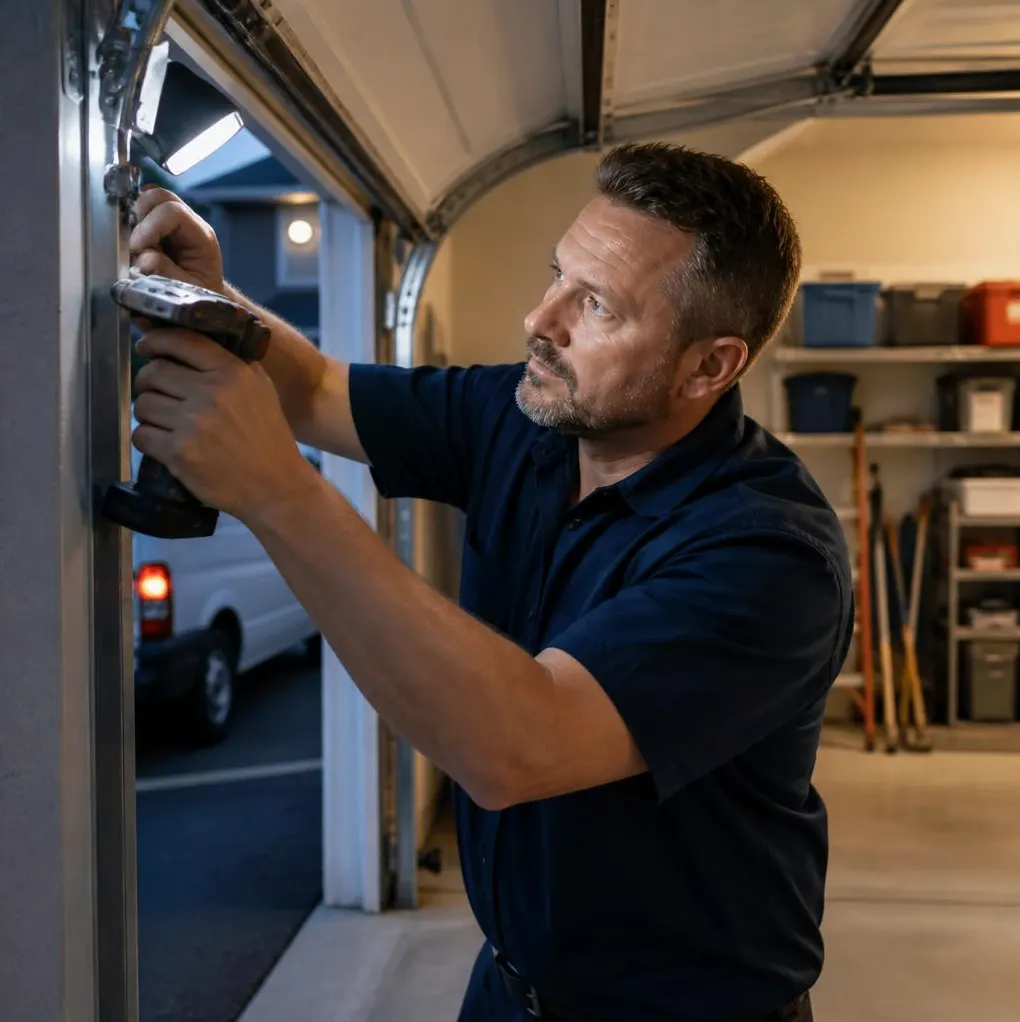
The moment you notice something's off
You walk out to the garage to grab a dumbbell or check on the new workbench, and you see it: a thin line of condensation running down the inside of the garage door, right above the rubber gym flooring or the new rug your spouse just laid down. Or maybe the door's started sticking a little when it opens, dragging against the weatherstripping it never used to touch. One of you says it's nothing. The other says it's a sign the whole conversion was a mistake. You're both a little right, and both a little wrong — here's what's actually going on.
The room changes, but the door is still a garage door
When a garage becomes a home gym, office, or workshop, everyone focuses on drywall, flooring, paint, and maybe a mini-split for air conditioning. What usually doesn't get touched is the garage door itself. That's the part people forget: the door is still rated, built, and installed as an exterior garage door, even after the space behind it stops functioning like a garage.
In South Florida, that matters more than in most places. Garage doors here are built to meet wind-load requirements for hurricane season, and that engineering doesn't change just because you moved a treadmill in. If the door ever needs to be replaced or repaired, it still has to perform the same job it always did: keeping wind and pressure out during a storm. A converted garage with a non-rated or damaged door is a weak point in the house, gym or no gym.
Temperature and humidity start fighting each other
Here's the part that catches people off guard. Once you condition the air inside — even with a small window unit or mini-split — you create a temperature and humidity difference between the inside of the room and the outside face of the garage door. In our climate, with heavy humidity and afternoon downpours most of the year, that difference shows up as:
- Condensation forming on the inside of the door panels, especially non-insulated steel doors
- Rust starting at the hinges, track, and bottom seal where moisture collects
- Wood-look or wood-composite doors swelling slightly, making them harder to open and close smoothly
- Musty smell near the door area, even when the rest of the room is dry
None of this means the conversion was a bad idea. It means the door itself often needs an upgrade to match the new use of the room — usually an insulated door, which also helps keep cooling costs down since you're no longer fighting a giant uninsulated metal panel for temperature control.
Clearance and weight get overlooked
The other common issue is purely physical. Gym equipment, shelving, and workbenches tend to creep toward the walls over time, and the garage door track runs right along that wall. A squat rack, storage rack, or pegboard mounted too close can interfere with the door's travel path or get clipped when the door opens. Cables and springs need their full range of motion — a few inches of clearance that looked fine on day one can become a problem once more equipment gets added.
If the opener is also working harder than it used to — straining, reversing, or taking longer to lift the door — it's worth checking whether anything heavier has been added to the door itself, like extra insulation panels or a new finish, without the opener's force settings being adjusted to match.
What to actually check this weekend
- Look at the inside of the door panels in the morning, before the room heats up — condensation is easiest to spot early
- Run a hand along the bottom seal and hinges for rust or pitting
- Check that nothing — racks, shelving, bikes — sits within a few inches of the track on either side
- Listen for new grinding, straining, or hesitation when the opener runs
If you're seeing more than one of these, the door isn't just a backdrop to the new room — it needs attention.
When to call in the garage door experts
If condensation, rust, or swelling is becoming a regular thing in your converted space, that's usually a sign the existing door isn't built for the new use of the room. Our team can walk through whether an insulated Garage Door Installation & Replacement makes sense, or whether a Garage Door Maintenance & Tune-Up — lubricating hardware, resealing the bottom, adjusting opener force — will solve it for now. Either way, we'll check the door against current wind-load expectations while we're there, since that's not something to guess about in hurricane season.
If your garage in Lake Worth Beach, Boynton Beach, Lantana, Greenacres, West Palm Beach, Palm Springs, Hypoluxo, or Delray Beach has turned into a gym, office, or workshop and the door is starting to show it, call Lake Worth Beach Garage Door Experts for same-day service and an honest look at what the door actually needs.