
The Mistake Most Homeowners Make First
When a garage door reverses halfway down or refuses to close, the first instinct is almost always to blame the opener itself. It's the part making noise, the part with the blinking light, the part that feels like the "brain" of the whole system. So people either try to reprogram it from scratch, order a replacement unit, or assume the motor is burning out. It's a tempting conclusion because the opener is the most visible, most electronic-feeling component, and swapping it out feels like a clean, one-step fix.
In reality, the opener motor is rarely the actual problem. Most reversing issues trace back to something much smaller and cheaper: a dirty sensor lens, a pinched wire, or a spring that's lost a little tension. A technician works through those possibilities first, in a specific order, before ever touching the opener's internals.
What This Actually Looks Like
A few patterns are worth noting, because they point toward different causes:
- Door drops a foot or two, then shoots back up. This usually means something is tripping the opener's obstruction sensors mid-travel.
- Opener hums or clicks, lights flash, door doesn't move downward at all. This almost always points to the safety sensors near the bottom of the tracks.
- Door closes fine most of the day but reverses in the late afternoon. Direct sun angling into a sensor's receiving eye can wash out the signal enough to cause a false reading, which shows up often in South Florida where the afternoon sun sits low and bright.
- Door reverses more often after a heavy rain or during a humid stretch. Swelling panels, rust forming on tracks, or moisture getting into sensor wiring can all cause intermittent reversing that seems to come and go with the weather.
What a Technician Checks, in Order
1. The Photo-Eye Safety Sensors
These are the two small sensors mounted a few inches off the floor on each side of the track. They have to be aligned with each other and free of anything blocking the beam between them. A technician checks the indicator lights first, then looks for a nudged bracket, a cobweb across the lens, or the kind of hazy film that salt air can leave on anything near the coast. The fix is usually just cleaning the lenses and realigning the brackets, though if a bracket has been bent or the mounting has loosened over time, it gets re-secured.
2. Sensor Wiring and Connections
If the sensors themselves look fine but the opener still won't recognize a clear path, the wiring gets checked next. Corrosion at the terminals, a loose splice, or insulation that's degraded from humidity exposure can all interrupt the signal intermittently, which is why this sometimes mimics a sensor failure. The fix is stripping and re-terminating the wire ends, replacing any corroded sections, and routing the wiring so it's not sitting against damp concrete or exposed to runoff.
3. Opener Force and Limit Settings
Every opener has a down-limit setting and a force sensitivity setting. If the force is set too sensitive, the door will reverse at the slightest resistance, even something as minor as drag from new weatherstripping. If the down-limit is off, the door may be hitting the floor harder than it should and triggering a reversal. A technician recalibrates both settings to the specific opener model and tests it with repeated open-close cycles to confirm it's stable.
4. Track Alignment and Obstructions
Next comes a physical inspection of the tracks themselves. Storm debris, a bent section from an accidental bump, or rust pitting on tracks near the coast can all cause the rollers to drag or catch at a specific point. This shows up as a reversal that happens at the same spot in the door's travel every time. The fix ranges from cleaning and lubricating the track to replacing a bent section outright.
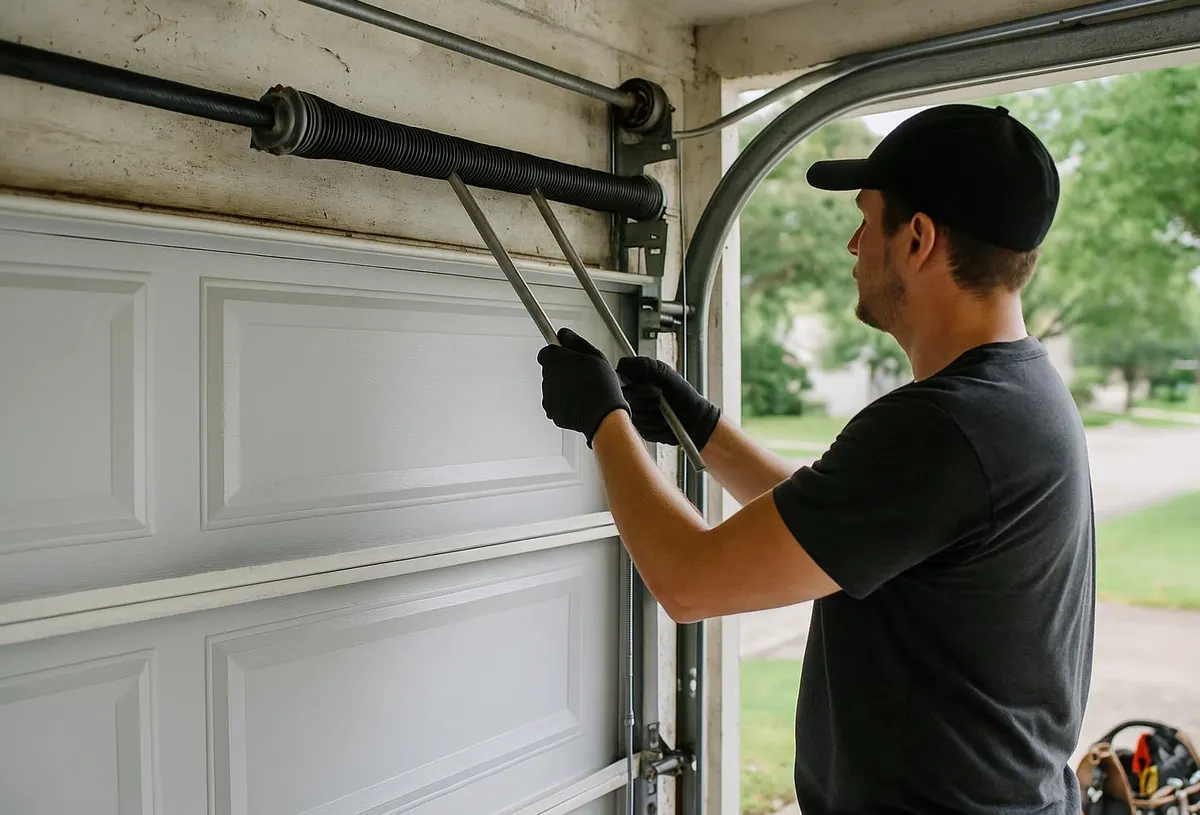
5. Springs Losing Tension
If the door feels noticeably heavier partway down, or the opener seems to be straining before it reverses, weakening springs are often the cause. Heat cycling and humidity-driven rust both shorten spring life faster in this climate than in drier regions. The opener reads the added resistance as an obstruction and reverses to protect the motor. Spring replacement is not a DIY job, and it matters that the replacement springs are sized correctly for the door, especially on wind-load-rated doors common in hurricane-prone construction.
6. Cables and Rollers
Last on the list are the cables and rollers. A cable that's frayed or has slipped off its drum can cause the door to tilt slightly as it travels, which throws off the opener's sensors and triggers a reversal or jam. Worn or rusted rollers, often accelerated by salt air, can cause the door to catch at the same points repeatedly. Fixes here involve cable repair or replacement and swapping out rollers, usually with nylon rollers for better long-term resistance to coastal corrosion.
When to Call Lake Worth Beach Garage Door Experts
If cleaning the sensor lenses and double-checking the alignment doesn't solve it, or if the door is reversing partway through its travel rather than right at the start, it's time to call in a technician rather than keep testing settings by trial and error. We start with a full diagnostic that covers sensors, wiring, track alignment, and spring tension, since those are the most common culprits in that order. If springs are the issue, our Garage Door Spring Repair service handles correct sizing and safe replacement. If the door is also binding or catching in the track, we pair that with our Off Track Door Repair service to get everything moving smoothly again, same visit in most cases.
If your garage door in Lake Worth Beach, FL is reversing when it shouldn't or won't close at all, give Lake Worth Beach Garage Door Experts a call today for same-day service across Lake Worth Beach and the surrounding area.